 Silofinance
 liquidations settle unsafe V3 loans through collateral sales or enabled collateral-debt swaps
Silofinance liquidations can seize collateral when a Silo V3 position's loan-to-value ratio exceeds its applicable liquidation threshold. Collateral-sale liquidations use sale proceeds to repay debt. An enabled collateral-debt swap (CDS) clears debt through internal accounting and compensates lenders with collateral share tokens. Crossing a threshold establishes eligibility; it does not establish that either settlement has executed.
The borrowing cap and the liquidation threshold govern different states. A position can lose further borrowing capacity before liquidation becomes available. The settlement path then determines how debt disappears and which asset or claim reaches lenders.
From borrowing capacity to liquidation eligibility
A Silo V3 loan becomes eligible for liquidation when its current loan-to-value ratio exceeds the applicable liquidation threshold. Current values govern that test, so an initially acceptable loan can later cross the boundary.
LTV compares the current loan value with the current collateral value: loan value divided by collateral value, expressed as a percentage. Accrued interest increases the debt side. A lower collateral valuation increases the ratio even when the borrower takes no additional loan. Those changes can move a position toward liquidation without another borrowing transaction.
Maximum loan-to-value (mLTV) sets the borrowing cap. Reaching that cap prevents further borrowing; it does not itself establish liquidation eligibility. The solvency test uses its own applicable threshold and valuation, so loss of borrowing capacity and eligibility for seizure are separate determinations.
Liquidation changes the outstanding debt and the collateral remaining in the position. Partial settlement can leave a continuing loan, while full settlement clears it.
Can repayment prevent collateral seizure?
Repayment can remove liquidation eligibility if it takes effect before liquidation and lowers the position's LTV below the applicable threshold. Adding collateral can also lower LTV by increasing the value that backs the debt.
- For an open position near or above its liquidation threshold, read current debt and collateral values before choosing repayment or additional collateral.
- Before choosing a repayment amount, include accrued interest in the outstanding debt; the original principal may no longer settle the loan.
- After submitting repayment, confirm that the resulting debt balance reflects the reduction.
- If the balance has not changed, do not assume that the planned reduction has taken effect.
- After debt decreases, check solvency against the liquidation threshold and borrowing capacity against mLTV before another balance change.
- If liquidation has intervened, stop relying on earlier balances and assess the remaining debt and collateral.
Oracle valuation for liquidation eligibility
Liquidation eligibility follows the market's solvency valuation, which can differ from the valuation used to set borrowing capacity. A token can use separate oracle configurations for those purposes. Matching the collateral token name therefore does not establish that two markets use identical prices or liquidation conditions.
Market-price oracles follow traded prices, while fundamental oracles can value an asset through its underlying redemption relationship. The relevant configuration determines which input enters the liquidation test. External price charts may show another valuation. Delayed updates, incorrect prices, or oracle outages can distort eligibility, including making an unsafe loan appear healthy or exposing a healthy position to incorrect liquidation. The market's Risk section identifies price sources, methodologies, and referenced feeds.
Collateral-sale settlement
A collateral-sale liquidation uses the collateral sale's proceeds to repay the affected loan, and its liquidation fee rewards the executor for performing that settlement.
Settlement size
The standard module supports partial liquidation, so a liquidation event does not always close the whole loan.
Partial settlement
A partial liquidation reduces debt and seizes the associated collateral. The remaining position still carries its outstanding debt and continues to accrue borrowing interest under the market's rate configuration.
Full settlement
A full liquidation may occur when a smaller settlement would leave an uneconomical residual balance, known as dust. The settled loan has no remaining debt, although the borrower still needs to distinguish seized collateral from any collateral left afterward.
CDS settlement without a collateral sale
An enabled CDS liquidation settles debt by reallocating collateral claims, without selling collateral for the borrowed asset. Lenders receive collateral share tokens through the Incentive Controller, which handles distribution to the loan side of the market.
CDS execution uses collateral share tokens only. The mechanism does not unwrap the underlying collateral or perform an onchain swap. This changes the settlement's liquidity requirements because the transfer can take place without an immediate collateral sale.
A CDS write-off does not return the borrowed tokens to the lending market. The protocol records repayment internally and reduces the borrowed-side asset accounting by the forgiven debt amount. Lenders lose the corresponding claim on the original loan asset and receive collateral compensation.
The write-off clears the liquidated loan's debt obligation. Lenders then have allocated collateral to claim through the lending app. Those shares retain exposure to the collateral's value, so their stated reimbursement value is different from cash proceeds already received.
Threshold ordering and CDS access
CDS can coexist with collateral-sale liquidation, with a higher liquidation threshold for the internal path when both routes are enabled. That ordering makes the swap a secondary settlement path. Crossing the earlier collateral-sale threshold does not by itself establish that CDS is available. D-LT names the collateral-sale threshold; CDS-LT names the internal swap threshold.
Collateral-sale liquidation is permissionless, while a market can restrict CDS to approved executors. Permission to use one route does not automatically confer access to the other. Authorization also leaves the applicable threshold test in place. The market's enabled mechanisms, thresholds, and access settings determine which settlement can operate on an unsafe position.
The fee split and its payment asset
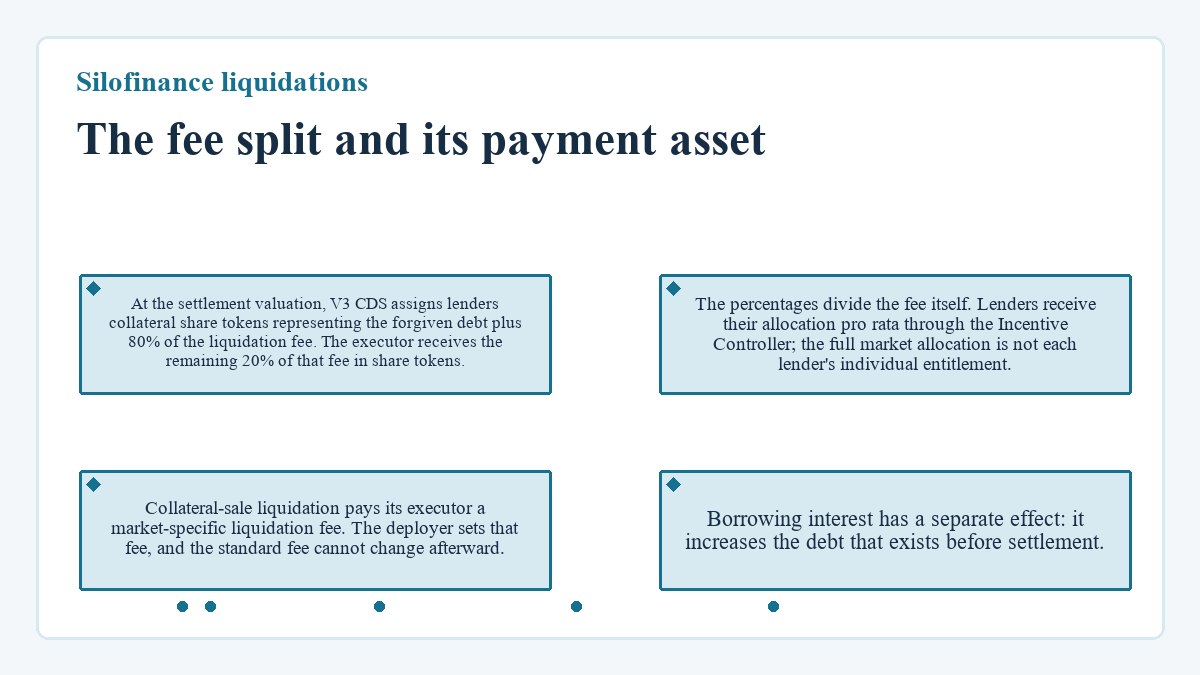
At the settlement valuation, V3 CDS assigns lenders collateral share tokens representing the forgiven debt plus 80% of the liquidation fee. The executor receives the remaining 20% of that fee in share tokens. The percentages divide the fee itself. Lenders receive their allocation pro rata through the Incentive Controller; the full market allocation is not each lender's individual entitlement.
Collateral-sale liquidation pays its executor a market-specific liquidation fee. The deployer sets that fee, and the standard fee cannot change afterward. Borrowing interest has a separate effect: it increases the debt that exists before settlement.
An eligible position can remain unsettled
Eligibility does not establish completed liquidation, because execution still depends on the available mechanism and its operating conditions. A collateral sale can stall when trading liquidity is shallow, price impact is high, or the liquidation reward fails to attract execution. Network congestion can also delay a transaction.
CDS avoids the forced-sale step when that route can operate. Its collateral reimbursement still leaves lenders exposed if collateral value collapses or other failures prevent adequate recovery. The existence of liquidation logic therefore does not establish repayment in the original asset or protection from every loss.
An unsettled unsafe loan can leave lenders facing bad debt if collateral becomes insufficient before effective liquidation. The resulting loss can reduce vault share value and obstruct withdrawals. Market-level risk isolation contains that exposure within the affected market; it does not supply replacement loan tokens.
Withdrawal boundaries after settlement
Remaining debt determines whether a borrower can withdraw all remaining collateral. A partial liquidation can leave an outstanding balance, and full collateral withdrawal requires complete repayment of that balance, including accrued interest.
Repayment burns the relevant debt tokens to reduce or clear the recorded loan. The remaining balance reflects interest accrual and any debt that liquidation has already settled. Seized collateral is no longer available for the borrower to withdraw.
Suppliers face a separate liquidity constraint when redeeming their loan-asset receipt tokens. Fully utilized liquidity can prevent an immediate withdrawal, even though the receipt token records a deposit claim. A CDS collateral allocation does not replenish that loan-asset liquidity. A lender can therefore have collateral to claim while still lacking liquidity to redeem the remaining loan-asset deposit.
Quick answers about Silofinance liquidations
Can I calculate liquidation LTV by dividing the raw token amounts?
Raw token counts do not determine liquidation LTV when the loan and collateral use different tokens. The ratio compares current values expressed on a consistent valuation basis. The applicable oracle configuration supplies the valuation input, so the solvency calculation can also differ from the one used to assess initial borrowing capacity.
Where can a liquidator read a market's collateral-sale fee?
A liquidator can read the collateral-sale liquidation fee from the market's SiloConfig contract. The deployer sets this fee for the market, and it cannot change afterward. A rate taken from another market does not establish the applicable charge. Borrow and supply interest rates describe different pricing inputs and do not substitute for the liquidation fee.
How is the collateral-sale liquidation module integrated into Silo V3?
The collateral-sale liquidation module is deployed as a hook through the Silo Hooks System. The hook implements liquidation, while the market's oracle supplies the valuation input. The CDS Incentive Controller has a separate distribution role.
Do liquidated borrowers have to return the tokens that they originally borrowed?
The settled portion of a liquidated loan does not require a second repayment from the borrower. Collateral-sale liquidation uses seized collateral to repay that debt, while CDS clears it through accounting. The borrower may retain previously borrowed funds. Any debt left after partial liquidation remains outstanding and must be repaid before full withdrawal of remaining collateral.
Does the CDS liquidation fee apply to every lender's deposit?
The CDS liquidation fee uses the debt being liquidated as its calculation base. It is not a percentage charge on every lender's entire supplied balance. The lender and executor percentages then divide that event's fee, with each lender receiving a pro rata allocation.
Can a fixed borrowing rate prevent collateral seizure?
A fixed borrowing rate does not remove the position's liquidation threshold. It determines borrowing interest under that configuration, while liquidation eligibility follows current debt and collateral values. Interest can still increase the loan balance at a fixed rate. A decline in the applicable collateral valuation can also push LTV above the threshold.
Is a high borrowing rate evidence that liquidation has happened?
A high borrowing rate does not establish that a liquidation has executed. Variable rates respond to utilization and the market's rate curve; liquidation concerns the position's LTV and applicable threshold. Expensive borrowing can coexist with a loan below its liquidation boundary.